
Honeywell Air Duct Cleaning in Huntington Beach: A Homeowner’s Guide
Honeywell air duct cleaning in Huntington Beach isn’t a separate service Honeywell sells; it’s a recognition that your Honeywell IAQ equipment, whether a media filter cabinet, UV system, or ventilator, only works to spec when the ductwork feeding it is clean and sealed. A Honeywell F100 media cabinet installed on a duct system with years of accumulated debris is filtering air that’s already been contaminated by the pathway it travels through. If you’d rather not tackle this yourself, call (877) 824-2949 for a free estimate from a crew that cleans and repairs ducts in the same visit.
We should be clear up front: Honeywell does not manufacture or sell duct cleaning equipment. They make the components that treat air inside the ductwork, and their engineering assumes a specific set of conditions to hit rated performance. In Huntington Beach, where coastal humidity, salt air, and construction dust from the constant remodeling cycle all enter return registers, those assumptions get tested daily. A quarter inch of caked dust on the interior wall of a supply trunk changes air velocity, which changes pressure, which throws off the very calculations a Honeywell TrueCLEAN UV system or an ERV relies on.
Why Honeywell IAQ Equipment Depends on Duct Condition
Let’s talk about what happens inside a Honeywell media cabinet when the ducts upstream are dirty. The F100 and F200 series use a 5-inch MERV 11 or MERV 13 filter that’s rated to capture particles as small as 0.3 microns, depending on the filter you buy. That rating assumes clean upstream air, because the filter’s job is to polish, not to strip layers of accumulated filth off duct walls. If your return trunks haven’t been cleaned in a decade, the filter loads prematurely. Static pressure rises. Airflow drops. The furnace blower works harder. And in a coastal climate like Huntington Beach, where many homes run AC six months out of the year, that extra load shows up as a real number on your bill.
We’ve measured this in homes near Newland and beyond: a clean system with a fresh F100 filter typically pulls 0.4 to 0.5 inches of water column static pressure, which is well within most blower curves. Same home, same filter, but with ten years of debris on the duct walls, and we routinely see 0.7 to 0.9. That’s a 40 to 60 percent increase in resistance, and no filter manufacturer can engineer around that.
Honeywell’s own documentation for their F300 whole-house electronic air cleaner states that the ductwork should be inspected before installation. They’re not being fussy; they know a compromised airway undermines their product. When you add a UV system like the TrueCLEAN UV1020 to the conversation, the sequence matters even more, because you’re introducing a line-of-sight treatment that only contacts particles suspended in the airstream. Debris that’s already stuck to the duct walls is unaffected by UV, and that’s the debris that keeps off-gassing and shedding into your living space.
The Correct Cleaning Sequence for Homes With Honeywell Filter Cabinets and UV Systems
Order matters, and here’s what we do on every Huntington Beach home that has both a Honeywell media cabinet and a UV germicidal lamp installed:
- Remove and bag the existing media filter. It’s loaded with contaminants that should not be carried through the house or re-exposed to the system.
- Power down and cover the UV bulb. Mercury vapor lamps are glass; a dropped UV bulb in a duct is a serious contamination event. We cover and remove them before any agitation begins.
- Clean the return side first. Air moves return to supply. Cleaning the return side first means dislodged particles are captured by our HEPA filtration rather than pushed forward into a clean supply trunk.
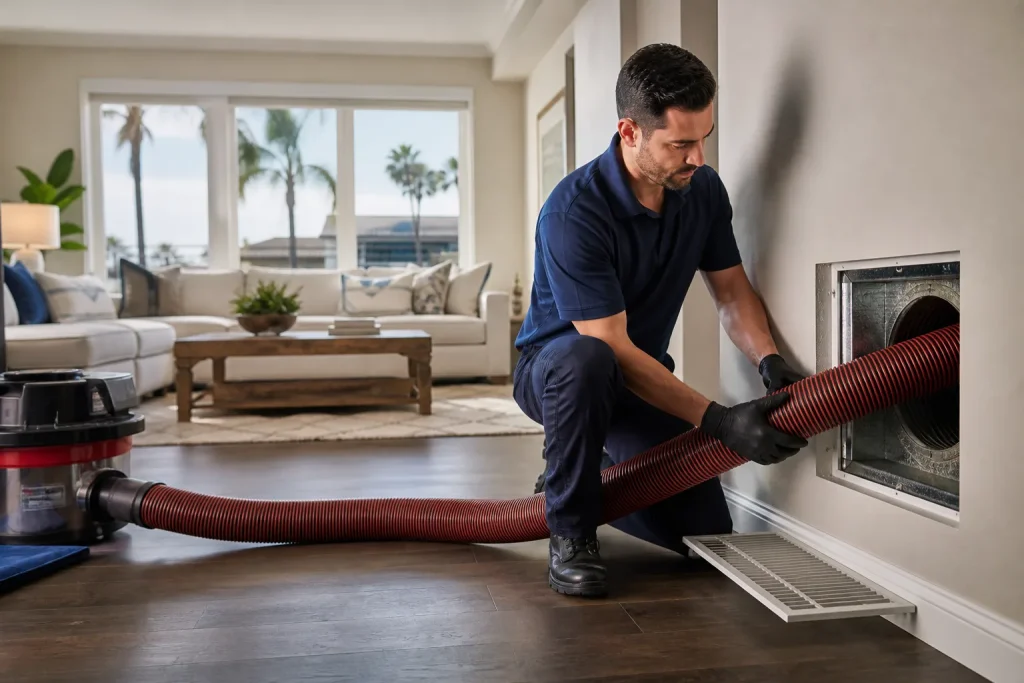
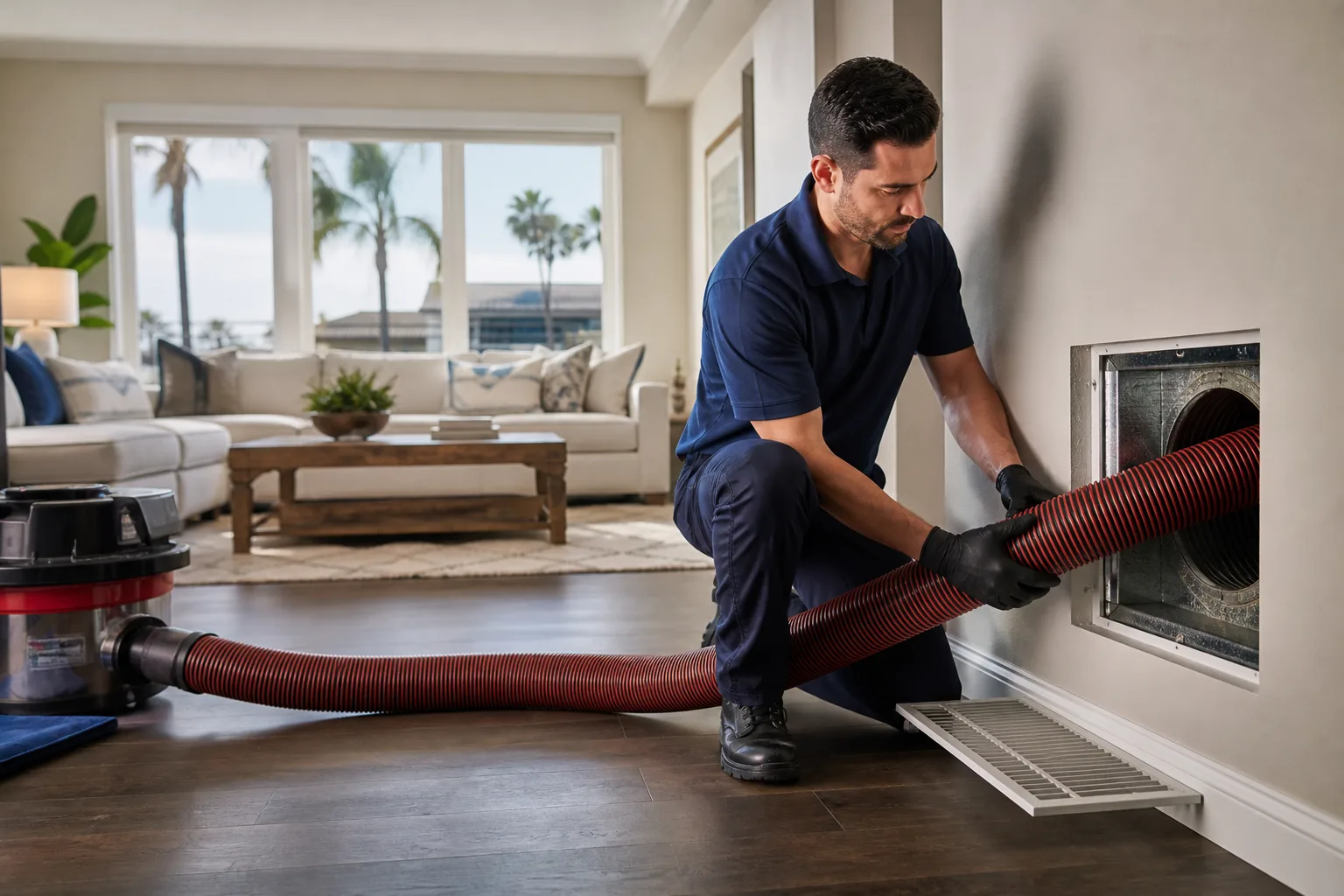
- Clean the supply trunks and branches second. Our Rotobrush system spins a rotary brush against duct walls to agitate adhered debris while a Nikro negative-pressure vacuum extracts it at the source.
- Verify the filter bypass seal. After the system is put back together, the 5-inch media cabinet has a foam gasket around the filter door. If cleaning knocked it loose, air bypasses the filter, which defeats the purpose of the cabinet entirely.
- Replace the media filter with a fresh one, or reinstall a washed electronic cell. Do not reinstall a loaded filter after cleaning; you’d be re-seeding the clean ducts.
The bypass seal check is worth emphasizing. We see this enough that it’s become a standard part of our post-service walkthrough: after a duct cleaning, a Honeywell 5-inch cabinet’s access door sits slightly proud or wobbles because the gasket got compressed during service. If you skip that check, filtered air leaks around the filter instead of through it. Your MERV 13 filter is now doing nothing. One tell is a fine dust line accumulating on the floor around the filter cabinet a few weeks after service. That’s bypass air carrying whatever the blower picks up straight past the filter.
How ERVs and HRVs Lose Their Rated Efficiency to Dirty Ducts
Honeywell’s TrueFRESH and VNT series ventilators, which include ERVs (energy recovery ventilators) and HRVs (heat recovery ventilators), are designed to deliver a calculated volume of fresh air per hour based on the ASHRAE 62.2 standard. That calculation assumes unobstructed duct pathways mounted within a specific static pressure budget. An ERV moving 120 CFM of fresh air through a dirty 6-inch flex run isn’t moving 120 CFM anymore; it’s moving whatever the fan curve says it can push against the higher resistance. In practical terms, a home in Huntington Beach that should be getting a full air change every three hours might be getting one every four or five, and the homeowner has no way to notice, because the ERV still hums quietly and the stale-air relief is subtle.
The bigger issue is moisture. ERVs transfer humidity between the exhaust and intake streams. In a beach climate, that moisture transfer is a meaningful chunk of the unit’s job. When the exhaust duct is partially blocked, more humidity stays inside the home, which means more condensate on windows facing the Pacific, more musty closets in older stucco homes, and a heavier load on the AC system. None of that shows up as an error code on the TrueFRESH control; it just accumulates slowly.
Debris load is the variable that breaks the spec. Honeywell publishes fan curves and efficiency ratings for their ventilators, but those numbers are lab numbers, clean duct numbers. A quarter-inch of dust lining the walls of a 6-inch flex run reduces the effective diameter from 6 inches to 5.5, and airflow is proportional to the square of the radius, so you’re not losing a little flow, you’re losing a meaningful percentage. Now add a sag in the flex run where debris has settled and hardened with humidity, and the run is effectively necked down to something smaller than the damper was designed for.
Honeywell’s Installation Docs Already Told You to Inspect the Ducts
Honeywell publishes installation guides for every IAQ product they sell, and virtually all of them, from the F100 media cabinet to the UV1020, somewhere in the first few pages tell the installer to inspect the duct system before installing the accessory. That’s not boilerplate. It’s an acknowledgment that the accessory’s performance is inseparable from the system it’s mounted into.
We pulled this exact situation apart on a job in a tract home over near Edwards Hill, where a prior contractor had mounted an F200 media cabinet onto a return plenum that had a disconnected interior liner. The liner had been flapping in the airstream for years, collecting debris and intermittently blocking the filter face. The homeowner had the right filter, the right cabinet, and no filtration at all for stretches of every blower cycle. The fix wasn’t another accessory; it was Air Duct Repair in Huntington Beach work: resecure the liner, clean the plenum, and remount the cabinet properly sealed.
When we inspect ducts before adding or optimizing Honeywell gear, here’s what we’re checking:
- Return duct integrity: Loose joints, disconnected sections, or tears in flex duct that pull attic or crawlspace air into the system upstream of the filter.
- Plenum condition: Debris, loose liner, rust, or gaps where the plenum meets the cabinet.
- Filter rack fitment: Does the Honeywell cabinet sit flat and square, or is it forced into an angle that leaves a bypass gap?
- Static pressure budget: Before any accessory addition, what is the current static pressure, and does the blower have headroom for the added restriction?
- UV line-of-sight placement: For TrueCLEAN UV systems, the bulb must be positioned where the airstream has been filtered first, not on the downstream side of the coil where it would be cooking wet debris.
We’re happy to do these inspections as part of a broader Air Duct Cleaning in Huntington Beach service, because most of the answers reveal themselves once the system is open and cleaning begins.
Maintenance Cleaning vs. Honeywell IAQ Optimization: They’re Different Jobs
Here’s the distinction that most generic duct cleaning write-ups miss: cleaning ducts for general maintenance is about removing accumulated debris so it stops circulating. Cleaning them to optimize a Honeywell IAQ investment is a systems-level job with a different set of acceptance criteria.
A maintenance cleaning ends when the duct walls are visibly clean and the debris load has been removed. We verify that with before-and-after photos of your actual ducts, taken from inside the plenum with our inspection camera. An optimization cleaning ends when the system can be verified to deliver the conditions the Honeywell equipment is rated for, which means:
- Static pressure with a fresh filter falls within the equipment manufacturer’s recommended envelope.
- No measurable bypass at the Honeywell cabinet gasket.
- ERV or HRV ducts flow within 10 percent of the rated CFM on the installed damper settings.
- UV bulbs are clean, seated correctly, and seeing the full airstream.
- All return connections from the living space to the filter cabinet are sealed, so the filter is actually seeing all the air it’s supposed to filter.
That second job is what we’re doing when a homeowner says they invested in Honeywell TrueFRESH or a full F300 electronic air cleaner and want to know why they’re not feeling the difference. The answer is usually not the Honeywell equipment; it’s the 40 feet of dirty duct upstream of it.
We also take care of the adjacent hazard that a lot of IAQ-focused homeowners don’t think about: the dryer vent. A clogged dryer vent is a fire risk and a moisture contributor that undermines whatever your Honeywell ERV is trying to accomplish. It’s a different system from your HVAC ducts, but it’s connected by the same goal: moving air out of your home so it doesn’t linger. We clean dryer vents with the same negative-pressure containment approach as the main ductwork, and you can read more about that on our Dryer Vent Cleaning in Huntington Beach page.
How to Verify the Work Was Actually Done
This is the question every homeowner should ask after a duct cleaning, and it’s especially important when Honeywell IAQ equipment is in play. Here’s what we tell Huntington Beach homeowners to check:
- Ask for before-and-after photos from inside the ducts. Not the register, not the return grille; inside the trunk and branch lines. If a contractor won’t show you interior duct photos, assume it wasn’t cleaned.
- Inspect the Honeywell filter cabinet door. It should close square with no visible gap or wiggle. Open it and look for dust streaks on the downstream side of the gasket.
- Feel the airflow at registers before and after. A properly cleaned and sealed system delivers stronger airflow through the same registers without changing blower speed. If a register is suddenly weak or silent, a duct section may have been disconnected during service.
- Check the UV bulb. If it’s covered in dust after cleaning, the cleaning was done without removing the bulb, which means the UV has been out of service the whole time. If it’s clean, and the window was checked for clarity, that’s a proper job.
- Watch the filter load. If a fresh 5-inch media filter starts showing heavy buildup within 2 to 3 weeks, there’s either an upstream duct breach pulling dirty air in, or the cleaning didn’t address the debris bed.
We use Abatement Technologies HEPA air scrubbers during every duct and dryer vent cleaning in Huntington Beach. The scrubber runs negative pressure on the workspace while the Nikro vacuum does the extraction at the duct opening, and the Rotobrush system scrubs the walls. The three tools work together, and the distinction matters: a Rotobrush without negative pressure just relocates the debris into the room; a HEPA scrubber without agitation just filters the air that’s already airborne; a Nikro vacuum without the brush just extracts the center of the airstream and leaves the walls coated. The equipment has to match the job, and the job has to be verified with evidence.
One more local note: Huntington Beach is full of homes built in the 1960s and 70s, many of them with original metal ductwork that’s now 50 or 60 years old. Those systems often develop pinhole leaks at the seams, disconnected branch runs, or collapsed flex sections added during later renovations. If you have a Honeywell TrueFRESH ERV installed on that aging duct network, the ventilator is working against leaks that no amount of filtration will fix. Air Duct Repair in Huntington Beach is a core part of what we do, not a referral to another contractor, because the same crew that cleans your ducts is the crew that should seal and repair them. Mixing two contractors on one contiguous air pathway is how corners get cut and warranties get voided.
The Bottom Line
A Honeywell media cabinet, UV system, or ERV is only as good as the ductwork it’s attached to. Clean ducts, sealed joints, and a verified filter bypass seal are the difference between realizing the clean air you paid for and running an expensive accessory on a dirty pipe. In Huntington Beach, where salt air and humidity accelerate dust accumulation and flex duct deterioration, that check needs to happen more often than the national average. If you own Honeywell IAQ equipment and haven’t had the ducts inspected since it was installed, start there. If you’re in Huntington Beach and need help, Platinum Air Duct Cleaning home offers free estimates; call (877) 824-2949 to schedule an inspection and get a straight answer about what’s inside your ducts.
Frequently Asked Questions
How often should I clean my air ducts if I have a Honeywell whole-home air purifier? In Huntington Beach’s coastal climate, plan on every 3 to 5 years, but inspect annually. The salt air and frequent construction dust in this area shorten the interval compared to inland climates. If you have pets, a smoker in the home, or live near a major road, lean toward 3 years.
Can duct cleaning damage my Honeywell UV system or media filter cabinet? A proper duct cleaning will not damage Honeywell equipment, and in fact it protects it. The risk comes from contractors who clean around the equipment instead of incorporating it into the sequence. The bypass gasket on a 5-inch media cabinet is the most common thing we see disturbed, and it’s part of our post-service checklist to verify it seals. The UV bulb should be removed and covered during agitation, then cleaned and reinstalled after the ducts are clear.
Why is my Honeywell air purifier not making a difference in my home’s air? The most common reason we see in Huntington Beach is simply dirty or leaking ducts upstream of the purifier. The filter or UV system is treating only the air that reaches it, and if debris is sloughing off the duct walls downstream of the purifier, it enters your living space untreated. Run a static pressure test with a fresh filter, and check for bypass around the cabinet door. Both are quick diagnostics that reveal whether the issue is the equipment or the airway.
Does cleaning my ducts help my Honeywell ERV work better? Yes. Honeywell’s TrueFRESH ventilators are designed to move a specific volume of air against a calculated static pressure. Debris-lined ducts increase that pressure, which reduces airflow below the rated CFM, which means fewer air changes per hour and more humidity staying inside the home. Clean the ducts, and the ventilator gets back to the fan curve Honeywell engineered for it.
Written by the team at Platinum Air Duct Cleaning, serving Huntington Beach since 2017.
Need Air Duct Cleaning Help?
Call Platinum Air Duct Cleaning - licensed & insured, here with fast help in Huntington Beach.
(877) 824-2949