
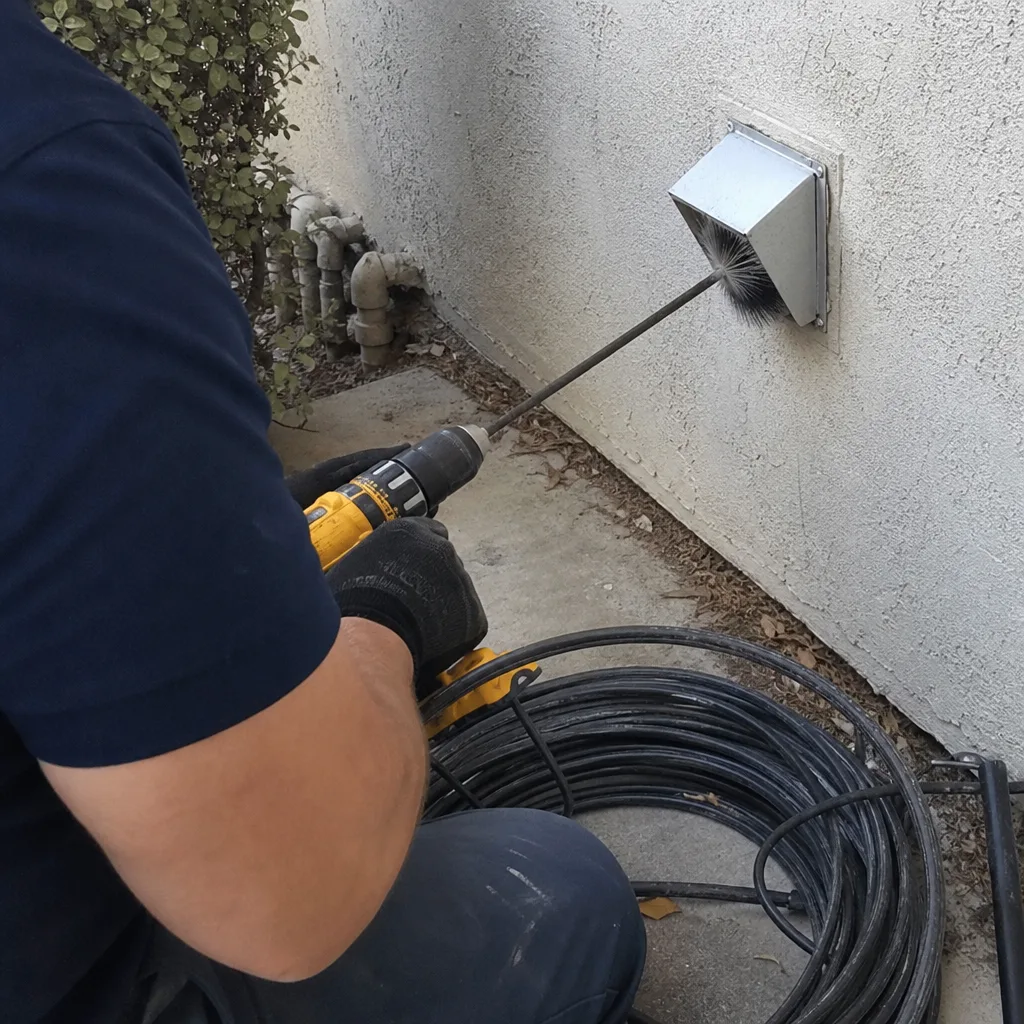
Last updated November 3, 2026
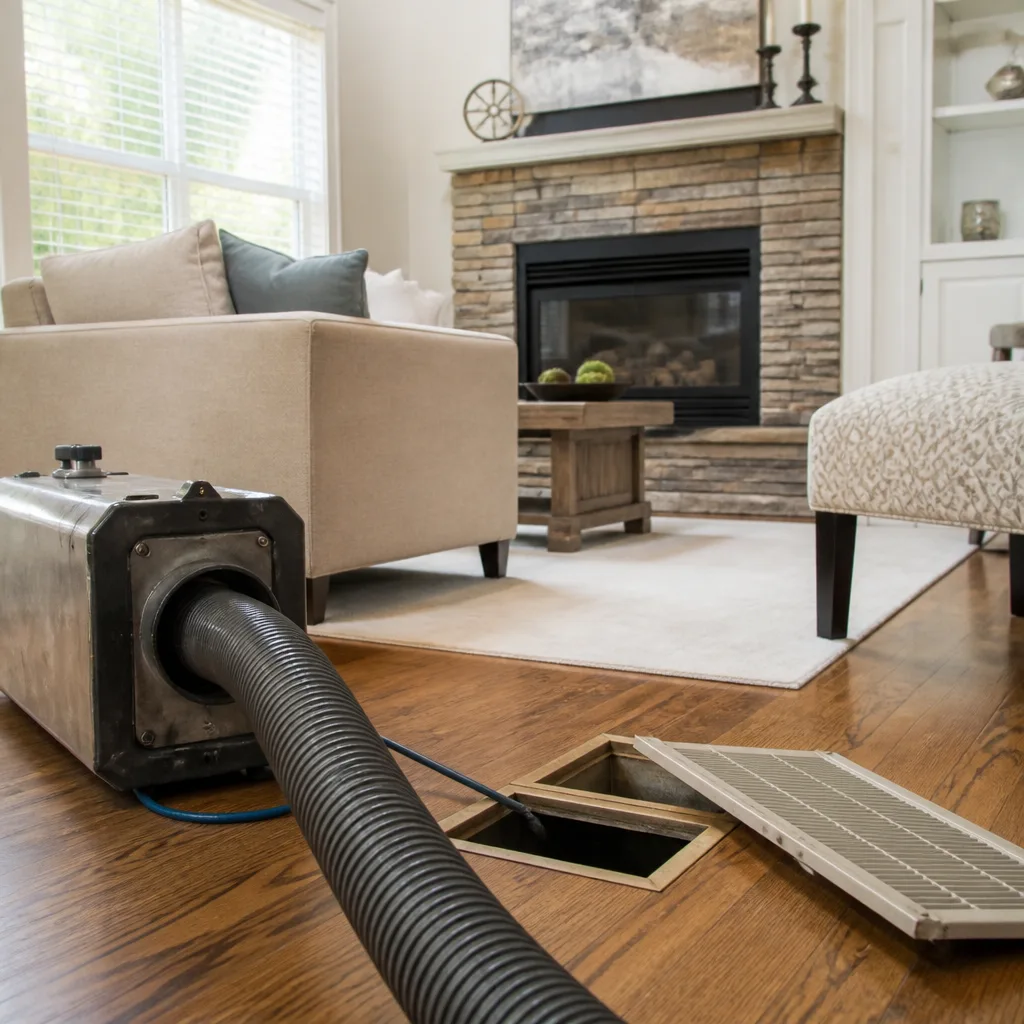 Whole-home duct cleaning
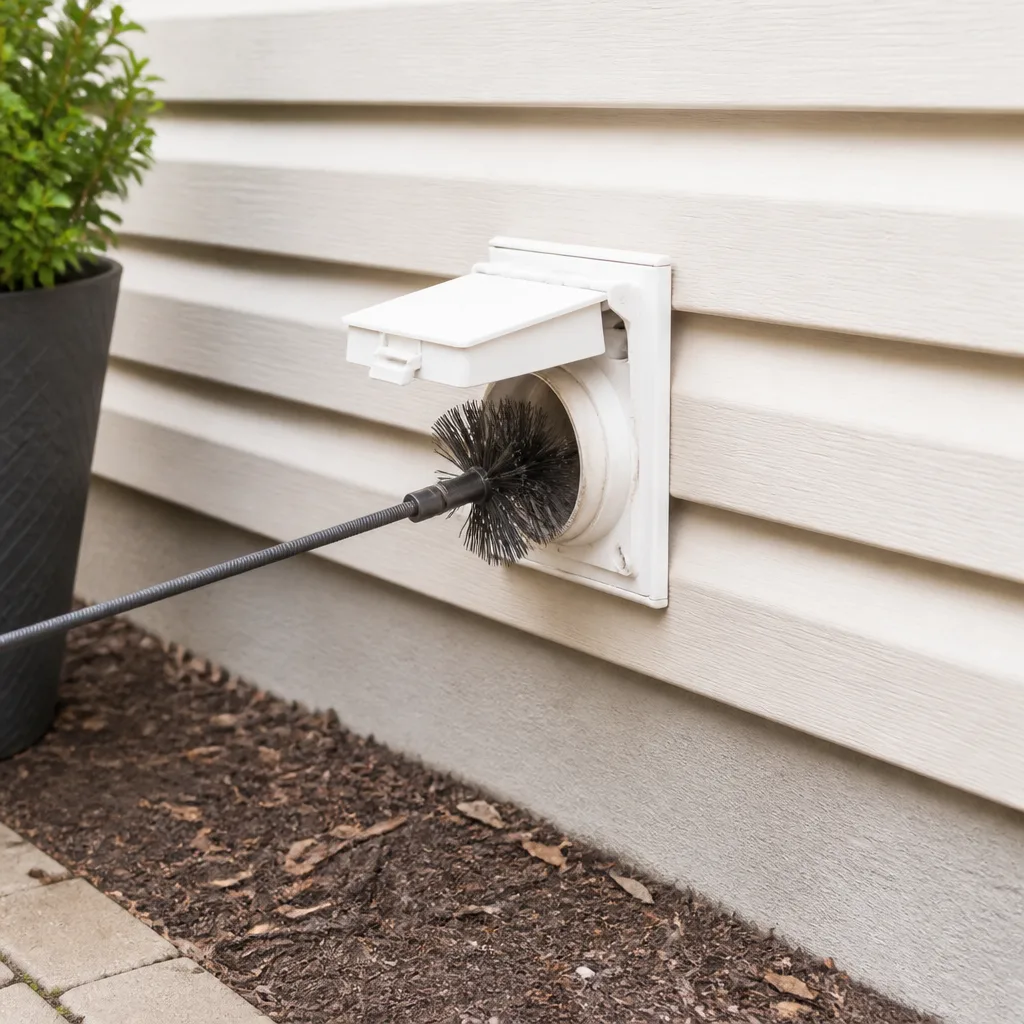 Dryer vent cleaning
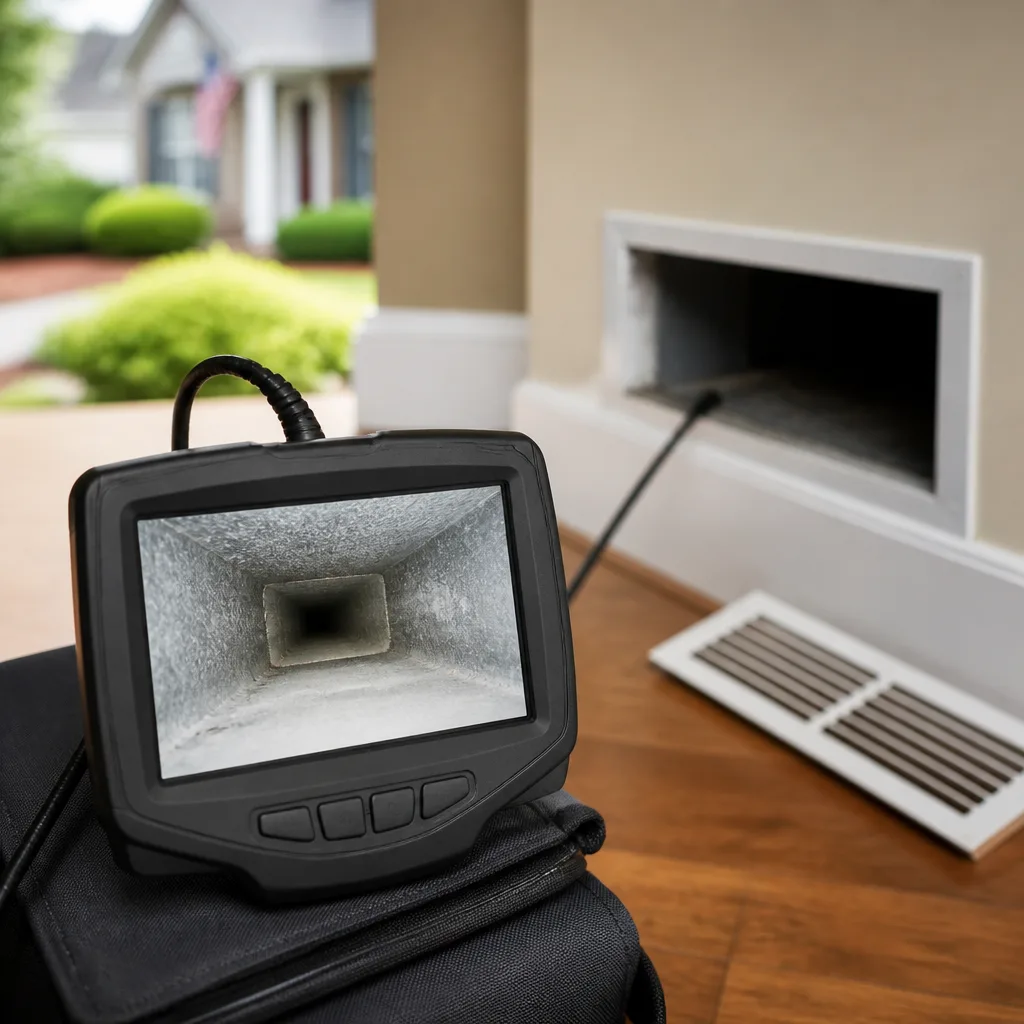 Camera inspection
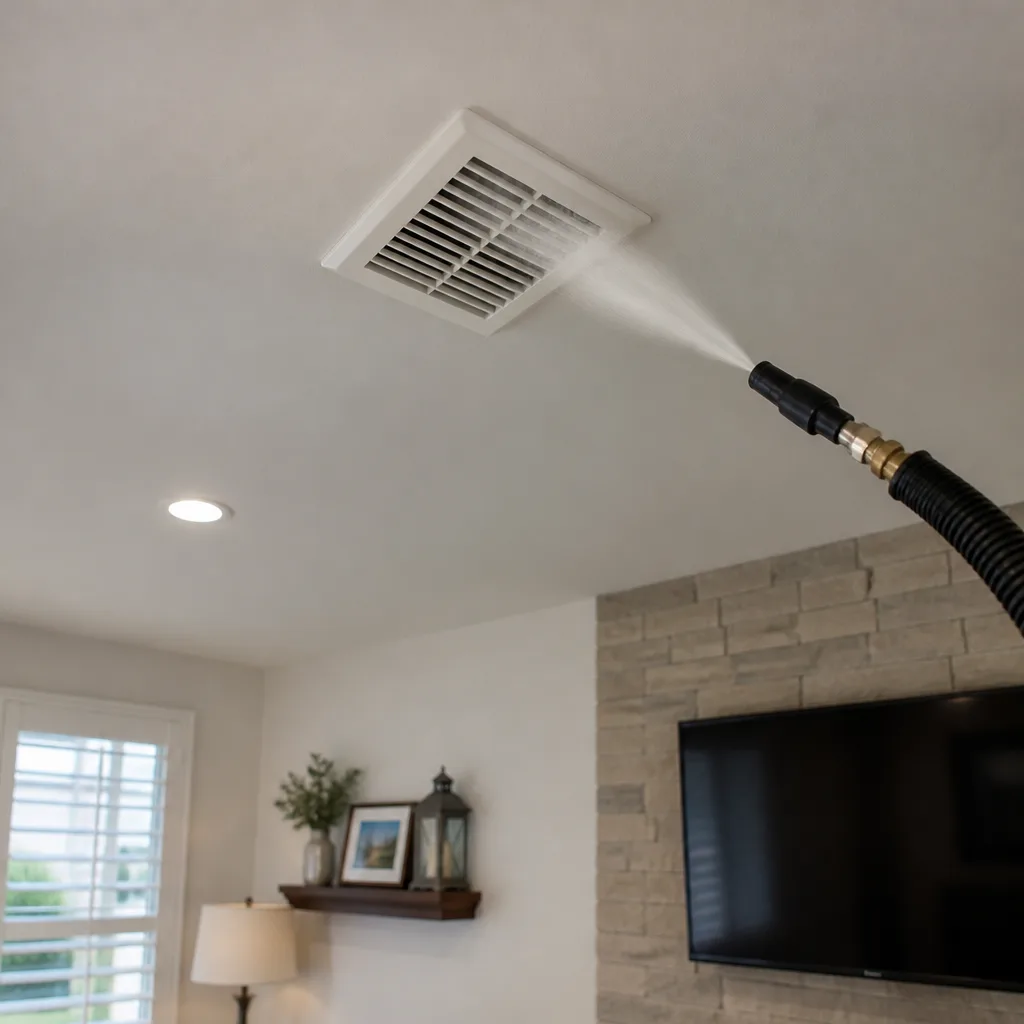 Sanitizing & deodorizing
Whole-system duct and dryer vent check with before-and-after photos - you see exactly what came out of your vents
That "$99 whole-house special" is a bait ad - the real number appears once they are in your hallway, or the "clean" is a shop-vac at the register. We photograph the inside of your ducts before and after instead.
Choosing the Right Air Duct Cleaning Brand: A Buyer’s Guide for Huntington Beach
Every duct cleaning company in Huntington Beach mentions Rotobrush somewhere in their marketing. It’s the most recognized name in the industry, so even operators running a consumer-grade Shop-Vac from their pickup truck will borrow the word to sound legitimate. But the actual difference between a $99 blow-and-go job and a real air-pathway cleaning sits in the equipment bay, not the sales pitch. The brands a company runs, the filtration they attach, and the mechanical process those tools perform are the only objective facts a homeowner can verify before the van arrives. Knowing how to read those facts, and which questions to ask, is what The Complete Air Duct Cleaning Guide for Huntington Beach Homeowners is for. We’ve spent years running professional-grade equipment through duct systems across Huntington Beach, and we’re going to explain what each major brand actually does, why it matters for your home, and how to confirm the truck parked in your driveway contains what the phone call promised.
Styles & brands we work with
- Whole-home duct cleaning
- Dryer vent cleaning
- Camera inspection
- Sanitizing & deodorizing
Quick Answer
The right Air Duct Cleaning brand for a Huntington Beach home is one equipped with an integrated rotary brush and vacuum system (Rotobrush), a high-CFM negative-air machine (Nikro), and, for homes with moisture or microbial concerns, a HEPA air scrubber (Abatement Technologies). More important than the brand name is verifying the company owns and operates this equipment on your job, because these tools are what separate a thorough cleaning that extracts debris from duct walls from a cosmetic pass that only clears the center of the airstream.
Table of Contents
- Why Equipment Brands Matter More Than Reviews
- What a Rotobrush System Actually Does
- Nikro Negative-Air Machines: CFM and Filtration Explained
- When Abatement Technologies Equipment Comes Into Play
- How to Verify Equipment Before You Book: 5 Questions That Work
- Why Equipment Investment Correlates With Accountability
- What Huntington Beach Homes Put Through Their Ducts
- Common Mistakes to Avoid
- When to Call a Professional
- Frequently Asked Questions
- The Bottom Line
Why Equipment Brands Matter More Than Reviews
Reviews tell you whether a company showed up on time and whether the technician was polite. They don’t tell you whether the cleaning actually removed the layer of fine particulates adhering to your duct walls, because the homeowner cannot see inside the ducts before or after the job. That’s the core problem with evaluating duct cleaning: you’re hiring for a result you can’t directly observe. The equipment brand and configuration, however, is a proxy you can verify. A Rotobrush rotary brush system, a Nikro negative-air machine, and Abatement Technologies HEPA filtration each perform a specific mechanical function with published performance specifications. These are not interchangeable marketing buzzwords. They are engineered products with CFM ratings, filtration grades, and mechanical designs that dictate what the machine can physically accomplish. Understanding those differences gives you a basis for comparison that no number of five-star reviews can replace.
In Huntington Beach, the coastal air carries salt, sand, and marine-layer moisture that settles into ductwork differently than the dry inland air of Fountain Valley or Westminster. Homes west of Beach Boulevard run air conditioning less frequently than homes further inland, which means longer periods of stagnant air and more particulate settling. That makes thorough duct-wall agitation more important here, not less. When you know what the equipment brand’s mechanical function is, you can assess whether the company’s process matches the contamination profile of your specific home.
What a Rotobrush System Actually Does
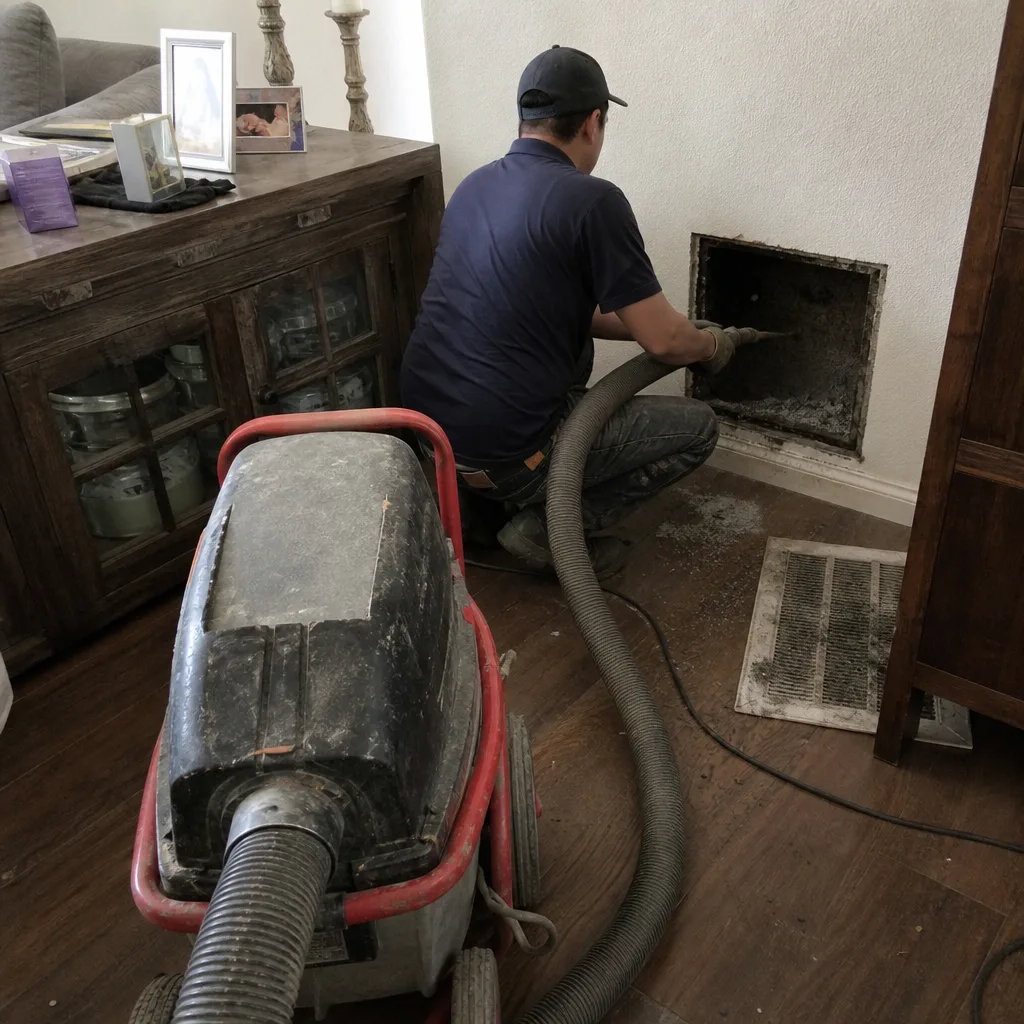
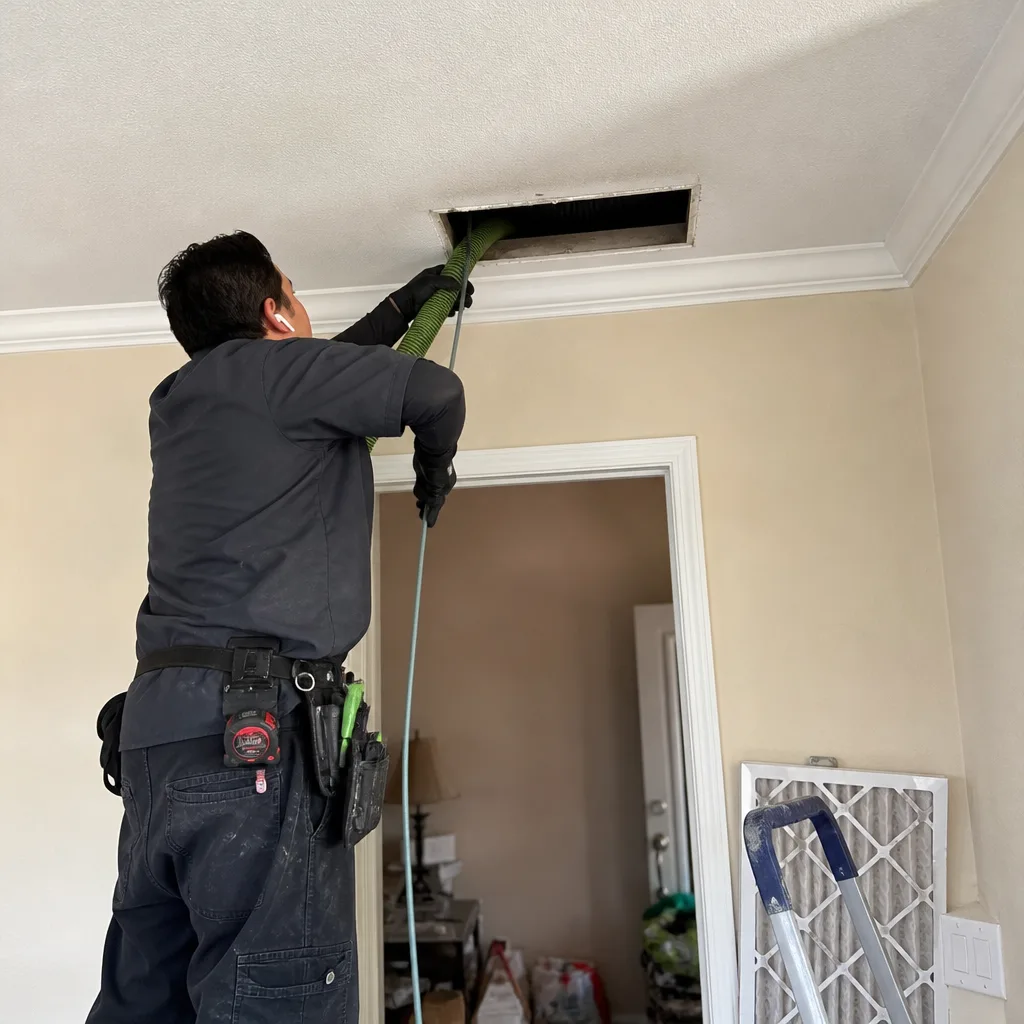
Rotobrush is not a vacuum. It is an integrated cleaning system that combines a rotary brush head with a vacuum collection mechanism in a single pass through the duct. The brush head spins against the interior walls of the ductwork, mechanically dislodging the adhered layer of dust, pollen, dander, and construction debris that has accumulated over years of airflow. Simultaneously, the vacuum component draws that loosened material out of the duct and into a collection chamber. This simultaneous agitation-and-extraction cycle is the key engineering distinction between professional systems and consumer-grade approaches.
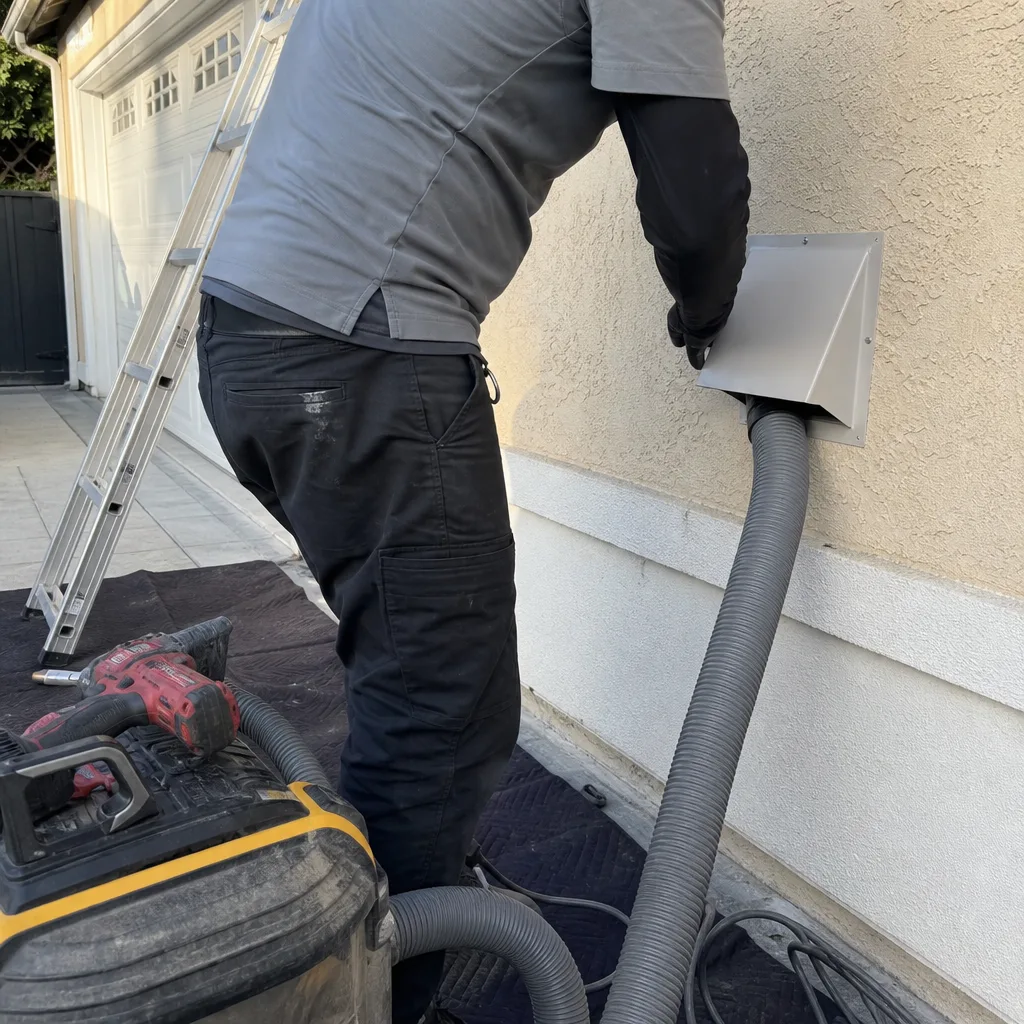
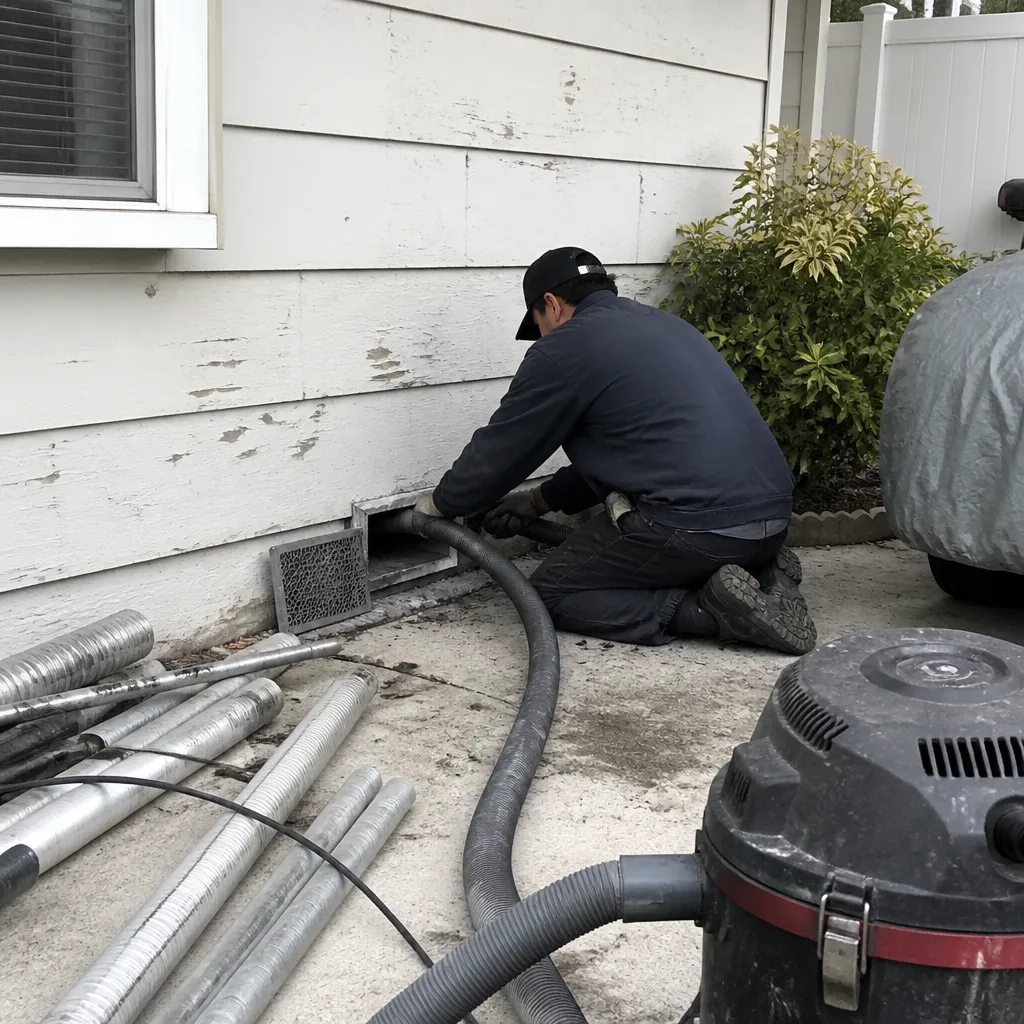
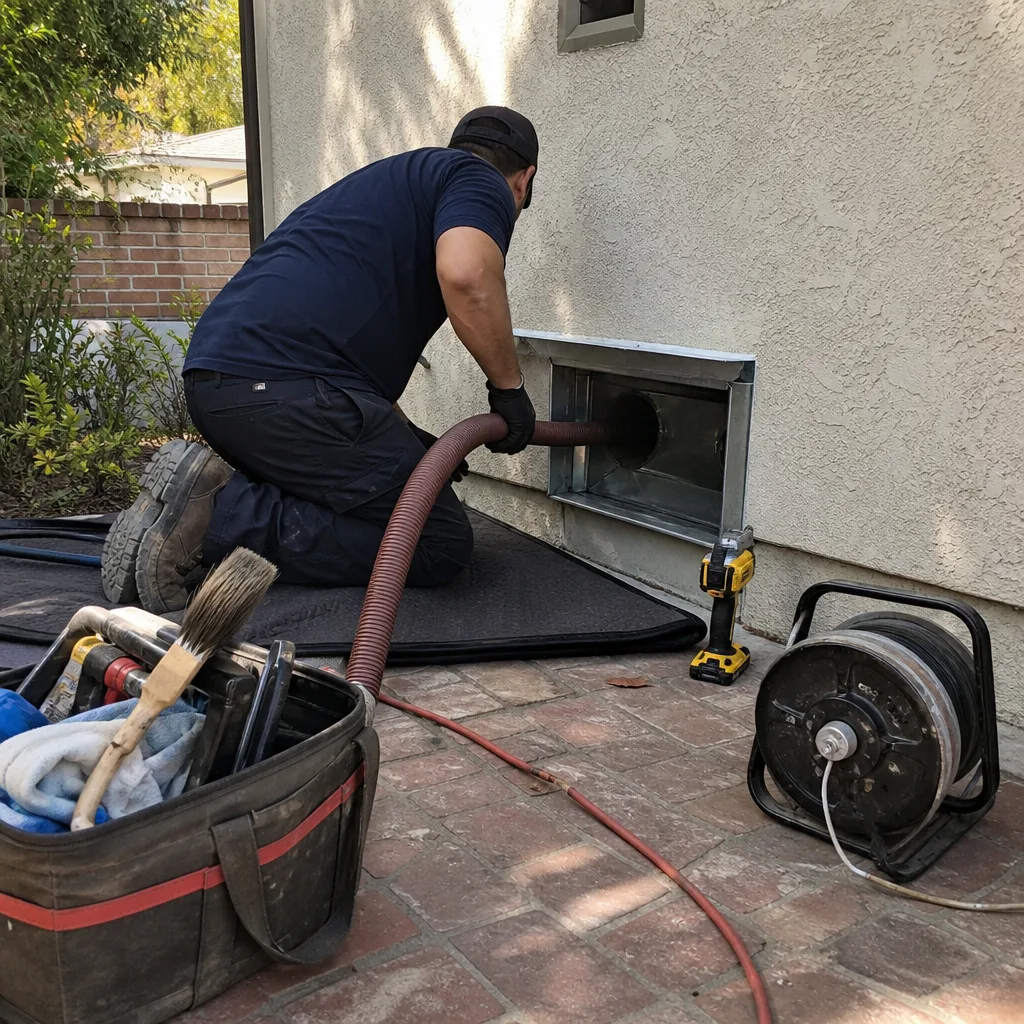
A shop vacuum attached to a long hose can only suction loose debris from the center of the airstream. It cannot dislodge the film that clings to duct surfaces, which is where the majority of fine respiratory irritants live. A rotating brush without integrated vacuum will loosen that debris but redistribute it into the living space rather than capturing it. Only an integrated system accomplishes both functions in one pass. Our Rotobrush system scrubs duct walls and extracts debris as it goes, which is why we can show measurable results rather than just describe them.
The distinction matters because “cleaning” a duct without agitating its walls is the equivalent of rinsing a baking pan without scrubbing it. The water runs through, the visible center clears, and the baked-on residue remains. In a Huntington Beach home where ocean air seeps in through window seals and leaves a fine salt-and-sand residue inside supply ducts, that baked-on layer is exactly what triggers recurring allergy symptoms even after a “cleaning.” The Air Duct Cleaning in Huntington Beach process, when done with the right equipment, starts with that physical agitation step because duplicating it by hand or with consumer tools is not possible at residential duct lengths.
Nikro Negative-Air Machines: CFM and Filtration Explained
Nikro is a manufacturer of air-filtration and negative-air equipment used in residential and commercial duct cleaning. The function of a negative-air machine is to create a zone of lower air pressure inside the duct system during cleaning, which ensures that any dislodged particles are drawn toward the collection point rather than drifting back into the living space. The two specifications that separate a legitimate Nikro unit from an imitation are its CFM rating and its filtration grade.
CFM, or cubic feet per minute, measures how much air the machine draws through the system per minute. A typical residential duct system in a 1,500 to 2,500 square-foot Huntington Beach home contains between 800 and 1,500 cubic feet of air volume depending on the number of runs and the home’s layout. A negative-air machine needs a CFM rating sufficient to exchange the air in the duct system multiple times during the cleaning process – generally 1,500 CFM or higher for residential work. Below that threshold, the machine struggles to maintain negative pressure across the full length of the duct runs, especially in single-story homes with long, sprawling duct layouts common in the Huntington Harbour and Seacliff areas.
Filtration grade is equally important. A true HEPA filter removes at least 99.97% of particles at 0.3 microns – the size range that includes mold spores, fine dust, and some bacteria. Many budget operators will claim HEPA filtration while running a standard pleated filter that captures far less. The Nikro systems we use provide verified negative-pressure containment during cleaning, which means the air leaving the machine is cleaner than the air already circulating in the home.
The truck-mounted versus portable distinction matters for sustained performance. Truck-mounted systems deliver consistent suction across long cleaning sessions because they draw power directly from the vehicle’s engine, while portable units can lose performance as filters load. Neither is inherently better for every job, but a company that cannot tell you the CFM rating of its equipment, or that hesitates when you ask whether the brush system integrates vacuum collection, is telling you something important about the depth of its operation. For more on how cleaning connects to the broader system, see our Air Duct Repair in Huntington Beach page, because damaged ducts undermine even the most thorough cleaning.
When Abatement Technologies Equipment Comes Into Play
Abatement Technologies manufactures air scrubbers and containment equipment designed for environments where airborne contamination must be actively captured. In residential duct cleaning, this equipment becomes relevant in specific scenarios: when mold or microbial growth is suspected or confirmed in the ductwork, when a home has undergone water damage, when occupants have severe respiratory conditions and need assured filtration during the cleaning process, or when a home has been exposed to smoke or particulate infiltration from a nearby event.
The function of an Abatement Technologies air scrubber is to draw contaminated air through a multi-stage filtration system, typically including a HEPA filter, and return clean air to the occupied space. During duct cleaning, the scrubber runs alongside the primary cleaning equipment to capture any particles that escape the negative-air containment zone. This is a safety protocol, not a marketing flourish. In a Huntington Beach home where marine-layer moisture has created condensation inside poorly insulated ducts, the cleaning process can dislodge biological material that should not be allowed to circulate through the living space. Abatement Technologies filters particles down to 0.3 microns, actively capturing dislodged contaminants during the service rather than recirculating them through the home.
This equipment is not always necessary for a routine cleaning in a dry, well-maintained home. A company that insists on running an air scrubber for every job is either doing appropriate due diligence or selling you something you don’t need. The right company will assess your specific situation and deploy the scrubber when the conditions call for it. We use Abatement Technologies equipment during service as the situation requires, and we’ll tell you plainly when it does and when it doesn’t.
How to Verify Equipment Before You Book: 5 Questions That Work
The phone call is where most homeowners get misled. A salesperson can name Rotobrush, Nikro, and Abatement Technologies without owning any of them. These five questions will reveal whether the company operates professional equipment or just borrows the vocabulary:
- “What is the CFM rating of your negative-air machine?” A legitimate professional can answer this immediately – typically 1,500 CFM or higher for residential equipment. A budget operator will pause, deflect, or change the subject. The CFM rating is a published specification, and anyone who owns the equipment knows it.
- “Does your brush system integrate vacuum collection in the same pass?” This is the Rotobrush distinction. If they describe brushing as one step and vacuuming as a separate step with separate equipment, the system is either not integrated or not a true professional-grade unit. Integrated simultaneous extraction is the standard professional configuration.
- “Does your technician arrive with the equipment, or is it rented per job?” Equipment rental is not automatically disqualifying, but it changes the accountability picture. A company that owns its equipment has made a capital investment that ties its business model to repeat customers. A company that rents per job has no stake in maintaining consistent performance across hundreds of cleanings.
- “What HEPA filtration do you run during the service?” If they say “we use HEPA filters,” ask for the specific equipment manufacturer. A HEPA filter in a consumer shop vacuum is not the same as a Nikro or Abatement Technologies machine. The right answer includes a brand name and a filtration grade.
- “Can I see the equipment when the technician arrives?” This seems obvious, but it’s the simplest verification method that exists. A company confident in its equipment will invite you to look at the truck before work begins. A company that hedges, or whose technician shows up with a small box and a long hose, has already answered your question.
Ask these questions, and listen to how the answers sound. A professional operator answers instantly because these are the tools of their daily trade. A salesperson pauses because they are constructing an answer. The pause is your data point.
Why Equipment Investment Correlates With Accountability
A professional-grade duct cleaning setup – integrated rotary brush system, high-CFM negative-air machine, HEPA filtration – costs between $30,000 and $75,000 to put on the road when purchased and maintained properly. That is a capital investment that low-cost operators simply cannot or will not make. The economic reality of that investment creates a behavioral difference that shows up in how companies treat their customers.
An operator who has invested tens of thousands of dollars in equipment must generate repeat business and referrals to amortize that cost. That means they cannot afford a disgruntled customer. They cannot afford to do a poor job, because a poor job produces a one-star review that undermines the investment. The equipment investment functions as a form of skin in the game. A blow-and-go operator using consumer-grade tools has minimal capital at risk and a business model built on volume, not reputation. One bad job doesn’t hurt them, because there is always another customer answering the next coupon.
This is not a moral judgment. It is a structural observation about how incentives work. When you hire a company with professional equipment, you are hiring a company whose business model depends on your satisfaction in a way that a consumer-grade operator’s model does not. The equipment is the tell. That’s why we lead with what we run, not with what we promise. Professional-grade equipment, not big promises. If you’re evaluating your options, start with a look at the Platinum Air Duct Cleaning home page to see the full picture of what professional equipment means in practice.
The same logic extends to ancillary services. A company with professional cleaning equipment but no capacity for repair will clean your ducts and then refer you elsewhere when they find a disconnected run or a leaking plenum. That referral breaks the accountability chain. We clean it, we repair it. The equipment investment and the repair capability are two facets of the same business model: one that exists to service the full air pathway system in your home, not just to spend an hour running a hose through your vents.
What Huntington Beach Homes Put Through Their Ducts
The air in Huntington Beach is not the same as the air in Anaheim or Irvine. Ocean proximity changes both the particulate load and the moisture behavior inside duct systems. Homes west of the 405, from Sunset Beach down through Huntington Harbour and into the downtown corridor, deal with a constant influx of salt-laden marine air that infiltrates through building envelopes and settles as a fine, clinging residue on duct surfaces. That residue is hygroscopic: it attracts and holds moisture, which means the duct environment stays damper longer than the ambient air would suggest. The result is a stickier, more tenacious contamination layer than the dry, dusty buildup typical of inland Orange County homes.
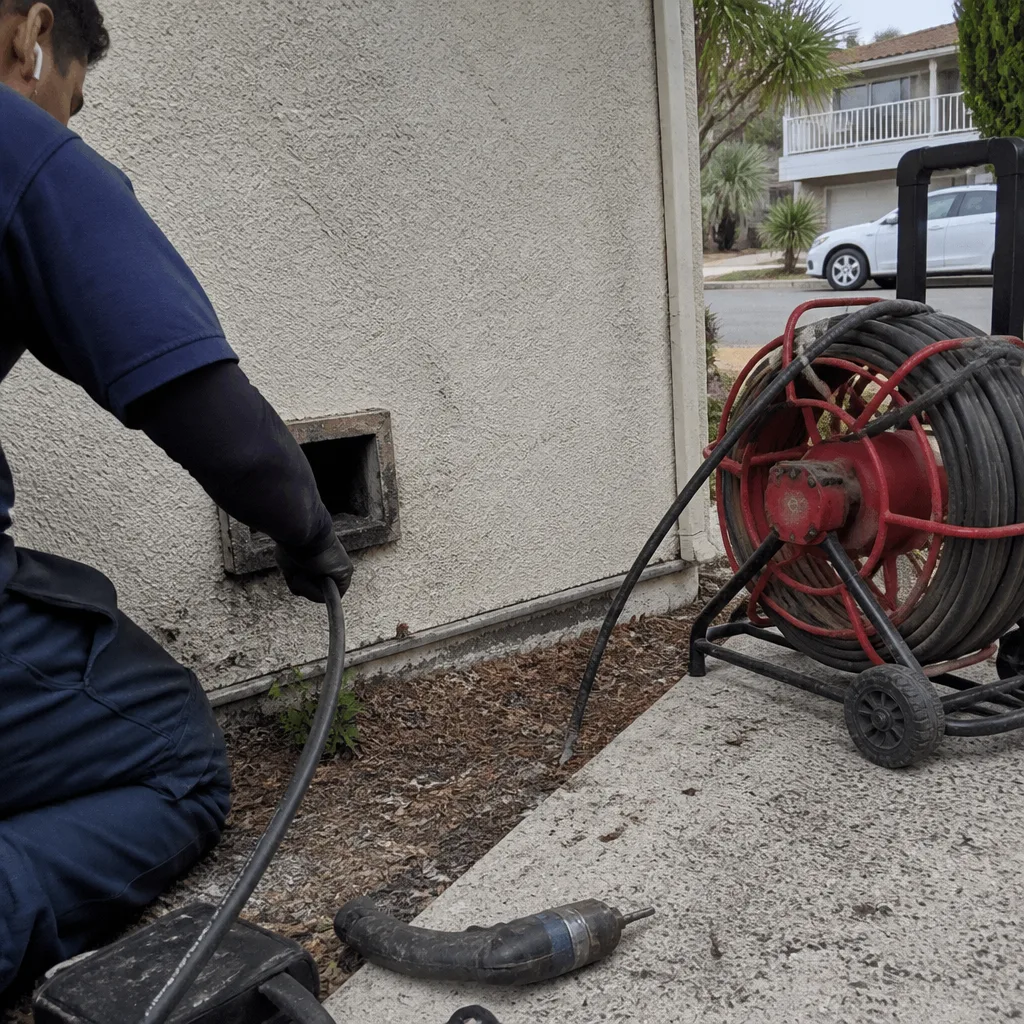
Sand is another Huntington Beach-specific factor. Beach neighborhoods from Bolsa Chica to the south of the pier see sand tracked in on feet, carried on clothing, and blown through open windows on windy afternoons. That sand works its way through return grilles and settles in the lowest points of return ducts. A cleaning that only addresses supply ducts, or that doesn’t physically agitate the duct walls where sand accumulates, leaves that material in place. The Dryer Vent Cleaning in Huntington Beach service addresses a parallel issue, since the same marine moisture that affects ducts also condenses inside dryer vent runs, creating the humid environment where lint clogs become a genuine fire risk.
Construction debris is a third category specific to Huntington Beach’s real estate pattern. The city has a high proportion of homes built between 1960 and 1985, many of which have been through multiple renovations. Remodeling debris, drywall dust, and the small debris of decades of occupancy collect in ducts that were never designed to be cleaned. A home in the Edwards Hill or Glen Mar neighborhoods that has been through a 1990s addition and a 2010s kitchen renovation often has ductwork carrying a stratified layer of material from each era. This is the situation where a rotary brush system’s ability to mechanically scrub walls, rather than vacuum what’s loose, produces the measurable difference in air quality.
The coastal climate also means Huntington Beach homeowners deal with a distinct seasonal pattern. Fall and winter bring Santa Ana winds that carry inland dust and allergens toward the coast, while spring and early summer bring the marine layer’s persistent humidity. The ducts experience both dry, dusty conditions and damp, condensation-prone conditions across the year. Equipment that performs a thorough mechanical cleaning in one visit, rather than a series of marginal cleanings, matches this seasonal swing because it clears the contamination layer entirely rather than leaving substrate for new accumulation to adhere to.
Common Mistakes to Avoid
- Hiring based on the lowest quoted price. A $99 whole-home duct cleaning cannot be performed with professional equipment, because the equipment cost alone exceeds that figure. The low price is a formula for either an incomplete job or an upsell once the technician arrives. Huntington Beach homes with their salt-and-sand contamination profile are exactly the homes where a marginal cleaning produces no measurable improvement.
- Accepting a per-vent pricing structure. Legitimate professional companies price the job as a system, not as a per-vent tally that expands during the service. Per-vent pricing is a mechanism for increasing the invoice after the technician is on site. Insist on one flat price for the entire duct system before work begins.
- Believing a brand mention without asking follow-up questions. Any company can list Rotobrush or Nikro on a website. The phone verification questions in this guide exist because the brand name alone means nothing. Ask for CFM ratings, filtration grades, and a clear description of the equipment’s mechanical process.
- Skipping the pre-cleaning inspection. A company that cleans without first inspecting the duct system – looking at returns, supplies, the plenum, and the filter housing – is working blind. The inspection is where a professional identifies disconnected runs, damaged sections, and the specific contamination profile of your home. In Huntington Beach, where renovation debris is common, skipping the inspection means skipping the diagnosis.
- Assuming HEPA means HEPA. “HEPA filtration” without a manufacturer name and a particle-size rating is meaningless. Consumer-grade filters labeled HEPA-adjacent do not capture the 0.3-micron particles that professional equipment is designed to handle. Ask for the specific filtration equipment manufacturers, not just the word HEPA.
- Not checking whether the company performs its own repair work. A company that cleans but cannot repair leaves you with a referral and a broken accountability chain when the cleaning reveals a problem. The right company handles cleaning, repair, and dryer vent service in-house. That single-source structure matters for the follow-through, not just the first visit.
- Buying a filter upgrade before cleaning the ducts. Placing a high-efficiency filter on a system with contaminated ductwork is like putting a clean bandage over an uncleaned wound. The filter clogs faster, the air remains contaminated, and the homeowner concludes the filter product doesn’t work. Clean the ducts first, then assess filtration. Cleaner air starts in the ducts, not the filter.
When to Call a Professional
Some situations cannot be resolved by changing a filter or running an air purifier. If you are seeing visible dust accumulating on registers within days of cleaning, if family members experience allergy symptoms that worsen when the HVAC system runs, if you have never had the ducts cleaned in a home you have lived in for more than five years, or if you have recently completed a renovation that generated drywall dust or construction debris, the ducts need professional attention. The same applies if you can see debris or dust inside a removed register, or if the home has a moldy or musty odor that intensifies when the system cycles on. These are indicators that contamination has embedded in the duct walls and will not be resolved by changing the air filter. Platinum Air Duct Cleaning offers free estimates in Huntington Beach – call (877) 824-2949 to schedule an inspection and get a flat-price quote for your system.
Frequently Asked Questions
A professional air duct cleaning for a typical Huntington Beach home, performed with equipment that includes an integrated rotary brush and negative-air machine, generally runs between $400 and $800 for the full system. The range depends on the home’s square footage, the number of duct runs, the accessibility of the system, and the extent of contamination. Homes with renovation debris, long disused systems, or damp-related contamination will be at the higher end of the range. Flat-rate system pricing, rather than per-vent pricing, is the structure to look for. Call (877) 824-2949 for an exact quote on your Huntington Beach system – estimates are free and the price is agreed before work starts.
Cheap quotes come from operators who are not running professional equipment. A $99 or $199 whole-home cleaning cannot cover the cost of an integrated rotary brush system, a high-CFM negative-air machine, and HEPA filtration, which means those operators are using consumer-grade tools that cannot physically dislodge the contamination layer on duct walls. The low price is a lead-generation strategy, not an honest quote. Once on site, the strategy shifts to upselling per-vent additions, filter replacements, and other add-ons that push the final invoice closer to, or above, the price a professional would have charged from the start. In Huntington Beach, where the marine residue on duct walls makes thorough mechanical agitation essential, a cheap cleaning is functionally indistinguishable from no cleaning. Get a flat-price quote before the technician arrives, and confirm the equipment they’ll be running.
The best verification is before-and-after photographic documentation from inside the ducts. Professional companies use inspection cameras to photograph the duct interior before cleaning and after cleaning, showing the condition of the duct walls in each section. If a company cannot or will not provide interior photos of your specific ductwork, you have no way to verify the cleaning occurred. Additionally, after a legitimate professional cleaning, you should be able to see clean duct walls through the register openings with a flashlight, and the volume of debris collected in the equipment’s collection chamber should be substantial in a home that has never been cleaned. For Huntington Beach homes that have accumulated decades of coastal particulate, the difference is visible. Ask about photo documentation when you book.
Huntington Beach homes should have their ducts professionally cleaned every 3 to 5 years, with variation based on proximity to the ocean, presence of pets, renovation history, and occupant health sensitivities. Homes west of the 405 that receive heavy marine air and sand infiltration may benefit from more frequent cleaning, while inland-adjacent homes with no pets and minimal renovation history may extend toward the longer end of the interval. Homes with allergy sufferers, asthma, or other respiratory conditions should lean toward the shorter interval. If you have never cleaned the ducts in a home you have owned for more than five years, the system is overdue. Schedule an inspection to assess the current condition rather than assuming the ducts are clean.
No home-grade vacuum system can physically dislodge the contamination layer that adheres to duct walls. A shop vacuum can clear loose debris from the center of the airstream and from the first few feet of duct accessible through a register, but the fine particulate that causes respiratory irritation clings to the duct surface and requires mechanical agitation from a rotary brush to remove. Attempting DIY cleaning with consumer tools mostly redistributes dust through the living space and creates the appearance of having addressed the problem. For the full length of residential duct runs, which can extend 30 feet or more from the air handler, professional equipment with integrated brush and vacuum collection is the only practical option.
Duct cleaning and dryer vent cleaning are distinct services addressing different systems and different hazards. Air duct cleaning addresses the HVAC distribution system – the supply and return ducts, plenums, and registers that move conditioned air through the home. Dryer vent cleaning addresses the dedicated exhaust run that carries hot, lint-laden air from the dryer to the exterior. The dryer vent is a fire hazard: accumulated lint restricts airflow, traps heat, and creates the conditions for ignition. In Huntington Beach’s humid coastal environment, lint becomes heavy and adhesive, compounding the restriction. Both services are important, but they require different equipment and different processes. A company that treats them as interchangeable is not being honest about either. For details on the dryer vent service, see Dryer Vent Cleaning in Huntington Beach.
The Bottom Line
When you hire a duct cleaning company in Huntington Beach, you are hiring a set of tools and the person who operates them, not a brand name repeated on a marketing page. For The Complete Air Duct Cleaning Guide for Huntington Beach Homeowners and more guides & resources, see our blog. The brands that matter are those whose mechanical specifications – CFM ratings, filtration grades, integrated brush-and-vacuum extraction – determine what the equipment can physically accomplish in your ducts. Verify the equipment on the phone, confirm it on the driveway, and insist on flat-rate system pricing agreed before work begins. A company that has invested in professional equipment, performs its own repair work, and documents the results from inside your ducts is structurally aligned with doing the job correctly. The equipment is the tell. Call (877) 824-2949 to see what professional-grade equipment means for your Huntington Beach home, with a free estimate and a flat price before anything begins.
Written by the team at Platinum Air Duct Cleaning, serving Huntington Beach since 2017.
See the difference
 Before
 After
 Before
 After
 Before
 After